Key Takeaways
- A newswire distributes your announcement. It doesn’t persuade a reporter to cover it.
- Trade journalists choose their own stories and delete pitches that are irrelevant, promotional, or mass-sent.
- Targeted, relationship-based pitching earns the third-party coverage that builds scientific credibility, search authority, and AI visibility.
Great news! Your successful funding round is about to close, a landmark dataset is approaching publication, or a long-awaited product is about to release. The release is approved, and the wire is booked. But the announcement goes out, gets reposted across a few dozen syndication sites, and then disappears.
A wire post is only one step in earning headlines. The real work happens before and after distribution: deciding which reporters get an early look, which angles each outlet will prefer, what each one needs to tell the story well, and who to follow up with.
What is the difference between press release distribution and media pitching?
Press release distribution posts your announcement to a newswire, which syndicates it to news sites, databases, and journalist feeds. It creates a public, timestamped record.
Media pitching is direct, personalized outreach to specific journalists whose beats match your story. A good pitch explains why the story matters to their readers and offers what they need to cover it.
| Newswire distribution | Targeted media pitching | |
|---|---|---|
| What it does | Publishes and syndicates your release | Persuades specific reporters to cover your story |
| Who sees it | Anyone monitoring wire feeds | Hand-picked journalists on your beat |
| How journalists respond | Often ignored, like other mass outreach | Higher engagement when relevant and personal |
| Value for search and AI | Creates an indexed record | Earns third-party coverage that AI tools cite |
| Best for | Routine updates, public-company disclosures | Launches, data readouts, funding, partnerships |
Why should we invest more than the distribution fee to announce our news?
- Because trade editors decide what gets covered, and they’re selective. In Muck Rack’s State of Journalism 2026 survey of nearly 900 journalists:
- 40% pitch and choose their own stories, and only 3% are fully assigned by an editor.
- 54% seldom or never respond to PR pitches.
- 88% immediately delete pitches that miss their beat.
- Targeted pitching provides journalists with what they say they want most: a description of why the news matters to their beat, interview offers with your scientists or executives, access to the underlying data, and, if appropriate, early access under embargo. Tailored pitches are written for specific reporters and often come from a familiar email address. A wire release can’t do any of that. What it mainly offers is pre-written quotes, which rank near the bottom of journalists’ wish list.
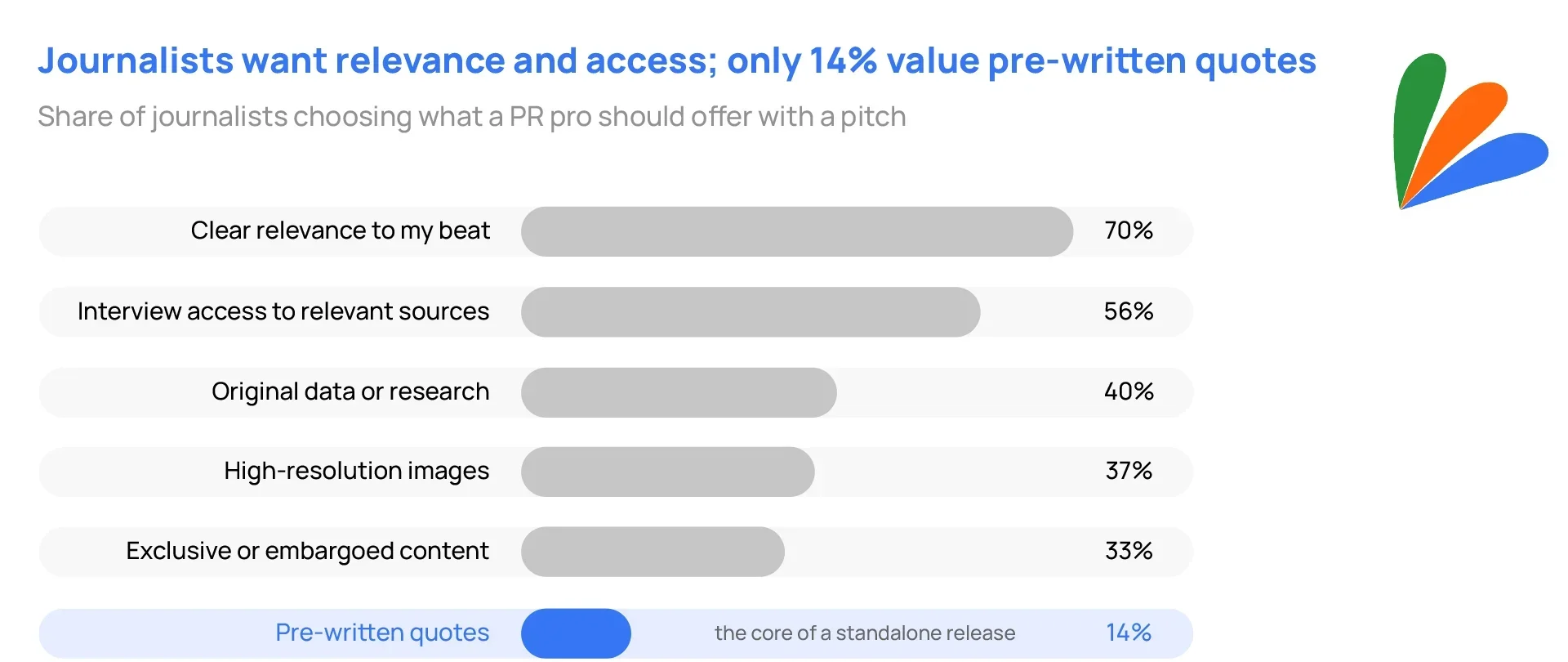
Source: Muck Rack, State of Journalism 2026 (897 journalists)
For life science companies, the bullseye is even smaller. A GenomeWeb reporter covering sequencing needs different context than a Fierce Biotech editor tracking deals, or a writer at The Scientist looking for the research story behind a discovery. One release sent to all three serves none of them well.
Why not send our news to hundreds of journalists instead of a select few?
Because mass outreach looks like mass outreach. Half of the journalists surveyed immediately delete pitches that look like a mass email, and 71% delete pitches that feel overly promotional.
The scientific trade press is a small community. Irrelevant pitches cost credibility that you’ll need for the next announcement. As one journalist in the survey put it: “Don’t pitch widely; pitch selectively, and then widen as needed.”
Precision pitching in action. For n6’s icon16 instrument launch, we pitched 13 trade and specialist journalists one-to-one, with each angle tailored to the outlet’s readers. 8 of 13 responded (61.5%). Seven outlets covered the launch, including GenomeWeb and GEN, generating 51 referral sessions and 69 new backlinks. Read the full n6 case study.
Your AI agent can send hundreds of pitches in minutes. But should you?
AI tools make it easy to generate personalized-sounding pitches at scale. But 82% of journalists now use AI tools too, and one survey respondent put it bluntly: “I can tell if you use AI.”
Scale never was and still isn’t the problem. Strategy and relevance are. The same logic explains why outbound blasts are losing ground across life science marketing. AI is useful for research, but deciding which reporter gets a first look still takes human judgment. More than half of journalists surveyed (53%) say their relationships with PR professionals are important to their success.

How does earned media affect search and AI visibility?
When someone asks ChatGPT, Gemini, or Perplexity about your technology category, AI tools lean heavily on third-party sources. Muck Rack’s What Is AI Reading? (updated in May 2026) research found that journalism consistently accounts for 20–30% of AI citations, while press releases make up a small, fluctuating share.
That’s why 55% of PR teams now pursue high-authority coverage specifically to improve AI visibility (Muck Rack, State of PR 2026). A feature in GEN, BioPharma Dive, or Technology Networks signals to search engines and AI tools that an independent source found your work worth covering.
Earned coverage also complements your owned-content strategy for AI search visibility. See how we improved our own AI visibility.
What does relationship-based pitching look like in practice?
- Before the announcement: Identify best-fit reporters. Offer exclusives or embargoed previews, coordinated with journal publication timing.
- On announcement day: Distribute the release for the record, and deliver tailored pitches, spokesperson access, and data to the right journalists. Pro tip: set your newswire release for an off minute to avoid getting lost in the flood of data releasing at the top of the hour.
- After the announcement: Follow up selectively, pitch trend stories and bylines, and meet editors at events like ASHG or AACR as part of a broader conference marketing strategy.
- Throughout: Keep claims scientifically accurate and compliant while emphasizing the key messages identified for the campaign ahead of release.
When is a newswire enough?
Wire distribution is the right choice for routine updates like leadership appointments, and it’s often expected for public-company disclosures. But even news that doesn’t need a full pitch round needs a crafted post in your own newsroom. Build that page out beyond the distributed release, with key takeaways, FAQs, data or visuals, and links to related announcements, so it becomes the canonical source that journalists, search engines, and AI tools find. The best strategy uses each tool for what it does well, starting with strong press release writing: the wire for the record, targeted pitching for the coverage.
Not sure which strategy is right for you? Reach out for a consultation

Why work with a specialized life science PR partner?
Large agencies often bring volume: big media lists, broad distribution, and generalist teams. Life science trade media rewards something different: scientific communication skills, senior attention, and relationships built one story at a time.
Samba’s scientific background helps us read through your technical content to pinpoint the broader impact of each announcement. We are aware of how important it is to get the angle, claims, and context right before a pitch goes out to a journalist. Explore our life science PR services to learn more about how we operate.
Frequently Asked Questions
Is a press release still worth sending?
Yes. It creates an official, searchable record. But on its own, it rarely earns trade coverage.
How many journalists should we pitch?
Fewer than you think. Start with a short list of best-fit reporters, then widen if needed.