“So how does CRISPR actually work?” My brother-in-law was apparently very bored on a long drive home from our family camping trip. About 30 seconds into my careful explanation, he stopped me.
“I feel like we’re playing Taboo again,” he said. “You’ve got a bunch of words that would make this way easier to explain, but you’re not allowed to say them, because I won’t know what they mean.”
(If you’ve never played Taboo, you have to get your partner to say a word, but the words you most want to use are all on an “off-limits” list that will elicit an obnoxious buzzer from your too-competitive cousin if you let them slip.)
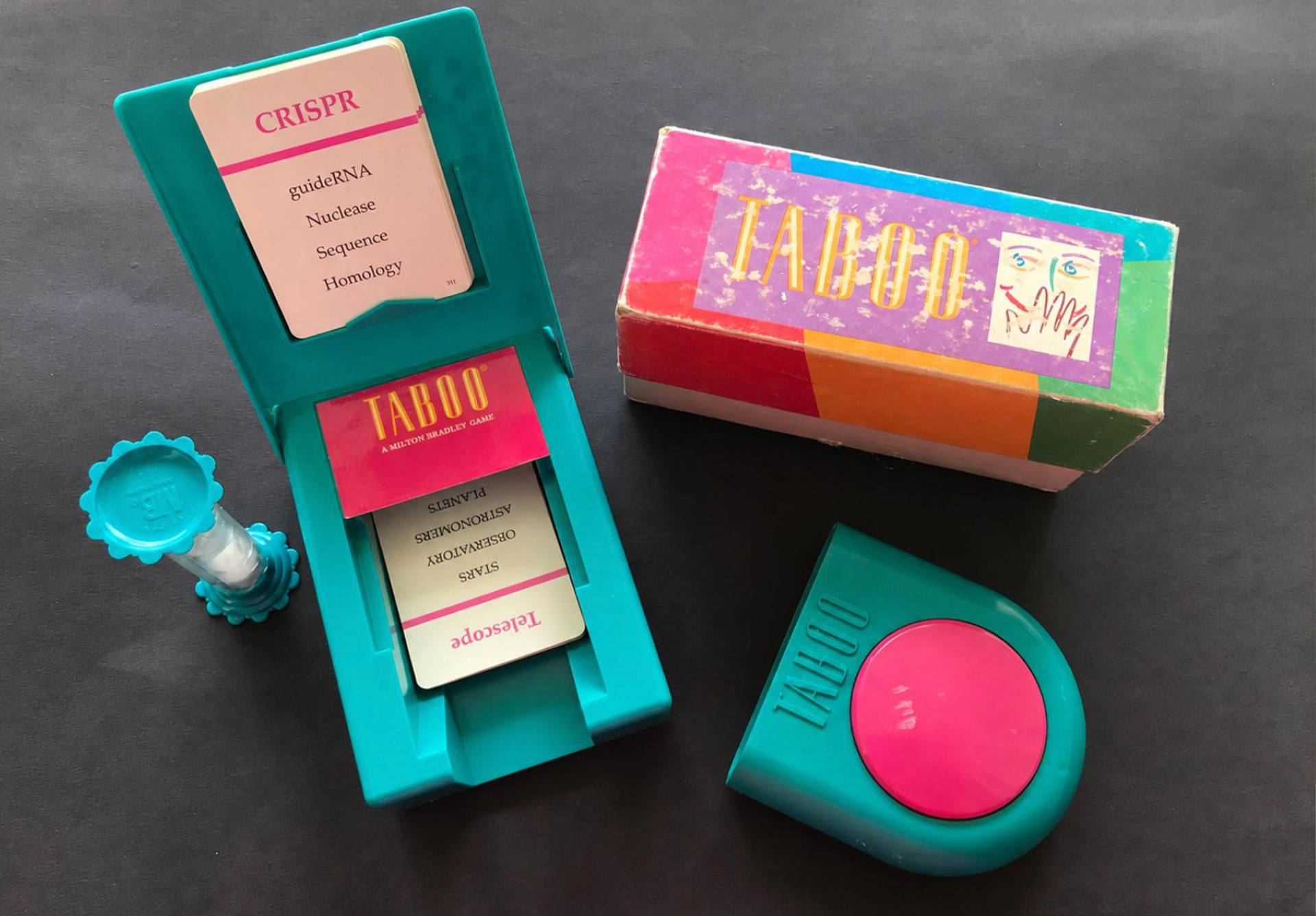
He wasn’t wrong. He also wasn’t unqualified to have this conversation (he owns his own healthcare software company). He just doesn’t have a biology degree, so every shortcut word I reached for (nuclease, guide RNA, sequence motif) needed a translation I hadn’t planned for. That’s the heart of scientific communication: realizing what background knowledge and biases you can’t take for granted.
I spent years at the bench: first worms, then plants, then yeast. I couldn’t make my mind up about what to study, which meant I was a newbie each time I changed fields—not a non-scientist—just not at the same level as the highly-specialized experts in the room. That experience shaped my ability to write and talk about science in outlets from local farmers’ markets to the Washington Post. Now, I do a version of that work at Samba Scientific, helping life science companies talk to their markets. Here’s what I’ve learned about why science communication matters, especially in B2B marketing, and why it’s harder than it looks.
Scientific communication isn't just for non-scientists
The default assumption is that scientific communication is a problem you solve for outsiders: the general public, a journalist, a patient advocacy group. Inside biotech marketing, that assumption causes real problems, because it implies your technical audience will just get it.
But just because they can, doesn’t mean they will. A researcher can chew through the density of a 12-page methods section. That doesn’t mean they want to. Attention is limited even for PhDs, and a technical reader who has to fight your content to understand it will just go read someone else’s instead.
There’s a second reason this matters specifically in B2B life science marketing: the person making the purchasing decision is often an expert in an adjacent field. A biomarker discovery scientist evaluating a new platform may be the leading expert on genomic oncology biomarkers, but that doesn’t mean they know the common pitfalls of proteomic or immunological biomarker analysis tools. (Our guide to writing for different life science personas gets into this in more detail.)
The people closest to the science are often the worst at explaining it
The deeper you go into a subject, the more vocabulary you pick up that feels ordinary to you and completely opaque to everyone else, and the harder it gets to notice the gap exists. That’s what caught me on the drive home. I wasn’t trying to sound cryptic. I genuinely hadn’t noticed how many words I was leaning on that only make sense once you already know the answer.
The same blind spot shows up with marketing jargon aimed at scientists, who now have to decode USP, MQL, or top-of-funnel the way my brother-in-law had to decode “nuclease.” Neither group is a captive audience, and both will disengage from language that asks too much of them for too little payoff.
What closes that gap is empathy with the audience: genuinely modeling what someone else does and doesn’t already know, as well as what matters to them, instead of assuming your own fluency and enthusiasm is universal. It’s the same skill, no matter what topic you apply it to, which is why our team of science communicators is as good at communicating how GEO works to marketing directors as we are at communicating AI target discovery platform benefits to their customers.
Meeting your audience where they are
There’s a phrase worth retiring here: “dumbing it down.” It implies the audience can’t handle complexity, when the real difference between reader and writer is usually context, not intelligence. A materials scientist and a molecular biologist can both be sharp and still fail to understand each other’s papers, not because either one lacks the horsepower, but because they’re fluent in different vocabularies.
Meeting a reader where they are isn’t about stripping information out. It’s about deciding, deliberately, which details matter to this particular reader, and that decision takes someone who understands the material well enough to know what’s essential and what’s just scaffolding.

One sentence that made a Nature paper click
Case in point, one of our account managers has a materials science background. She shared a Nature paper in our group chat, genuinely excited about a new quantum material. The rest of us, all PhD biologists/biochemists, read the abstract and had no idea why it mattered. So, we asked her to explain it.
Her answer: “Quantum computing needs cryogenic cooling. But not anymore! Put it on your regular chips!”
That’s it. No jargon, no hedging, and nothing lost that a biologist actually needed to grasp the significance. She knew exactly how to explain the “so what,” because she understood the material and her audience well enough to know what to leave out.
The same science, three audiences
- The peer-reviewed paper in Nature Communications was written for a captive, deeply expert audience by the scientists who did the work. It gets into the specifics about the antibody’s conformational epitope on the Pfs230 protein. Details researchers wishing to repeat their work would care about.
- We helped the iRepertoire team produce a webinar about the same findings. In this case, the audience was time-limited industry and pharma scientists: generalists relative to those who would find and read the academic paper organically, but by no means a lay audience.
- In a press release we wrote for journalists and B2B decision-makers, we reached for a visceral comparison (bulk sequencing is like drinking a fruit smoothie, you lose the individual ingredients) and described the find as a needle in a haystack that kept turning up in the same spot.
When a picture is worth the paragraph
We lean on this instinct constantly in the content and video work we produce for clients.
For n6’s AutoNorm platform, we helped demonstrate the consequences of uneven PCR amplification with a steak-toast-marshmallow cooking analogy: some samples need a light toast, others need a long sear, and fixed-cycle PCR amplifies them to the same amount regardless.
For Helio Genomics, we crafted an animated explainer video around DNA as a busy street, genes as the cars on it, and methylation as the traffic signal: cancer makes some cars speed up and others stop dead, and the platform’s job is to read that traffic pattern like a report.

Why we hire for this specific instinct
When we’re hiring PhD-level account managers, we look for excellence at the bench, but, more importantly, we look for impact OUTSIDE of the lab. The best science communicators were the graduate students who spent more time making their posters legible from six feet away than making them sound intelligent up close (that move also often won them poster awards). The ones whose papers got cited because they were readable and had a great visual abstract. The ones who spent their weekends talking about their work at “brews & biotech” events or elementary school science fairs instead of chained to their bench.
A strong desire to ensure their science was understood, not just correct, is the trait we actually screen for. It matters more than the subfield on someone’s diploma, because the underlying skill is what this whole piece is about: knowing your audience well enough to make good decisions about what they need from you. (We’ve written more about how that plays out when scientists and creatives work side by side here.) Incidentally, that ability to identify gaps and fill them also helps our team self-educate on a wide variety of topics outside of their personal expertise.
It’s also why our content performs. Buyers trust it more, because it reads like someone who understood the science well enough to explain it honestly instead of dressing it up. (More on how that trust gets built in Building Biotech Brands That Scientists and Investors Trust, and on how it eventually shows up in the pipeline in Biotech Lead Gen in 2026.)
Alright, we’ve talked a lot about the warm fuzzies of science communication, but if you want to see how these skills translate into real commercial impact, just check out our case studies page. There are dozens of examples of science communicators building content and a plan that got attention, drove traffic, and generated leads. The data speaks for itself.
FAQ
What is scientific communication in a marketing context?
It’s the practice of translating technical or scientific information for a specific audience without losing accuracy. It means deciding which details a reader needs and which ones are getting in their way. In life science marketing, that audience is often technical itself, just not expert in your exact niche.
Why does content marketing for biotech need scientific communication skills?
Because all of the decision makers in your buyer’s journey are rarely experts in your specific subfield. And because, even if they are, they are time limited, and it’s important to focus on what matter most to them. For more on structuring content around a variety of audiences, see our life science content marketing guide.
Is simplifying complex science the same as "dumbing it down?"
No. “Dumbing down” implies the audience can’t handle complexity. Good simplification is an editorial decision about which complexity is relevant to a specific reader, made by someone who understands the material well enough to know the difference.
Do technical audiences, like scientists or KOLs, still need accessible content?
Yes. Being capable of reading dense material doesn’t mean an audience wants to. Attention is limited even for experts, and content that respects that will outperform content written for a captive reader.
What makes life science marketing different from other B2B marketing?
The subject matter is often genuinely hard to picture (molecular mechanisms, biological processes, lab workflows), and the audience spans a wide range of technical fluency, sometimes within a single buying committee. That combination rewards marketers who can move fluidly between registers.
How can a marketing team get better at scientific communication?
Practice noticing your own blind spots, the vocabulary you use without registering that it needs translation. Build the habit of asking what a specific reader already knows before you write. Hiring people with a demonstrated interest in communicating clearly, not just people with technical credentials, helps more than most teams expect.
Is scientific communication a good career path?
Yes, and the paths into it are broader than most people assume. Science communicators work in journalism, journal editing, agency and in-house marketing, PR, science policy, museum and outreach education, and medical communications, among others. The common thread across all of them is translating technical material for a specific audience.
What skills do employers look for in science communication hires?
The ability to explain technical material clearly and accurately, without over-simplifying or losing precision. Strong writing or presentation skills. Evidence you’ve actually done it: a publication record with readable papers, science journalism clips, an award-winning poster or talk, an outreach project, a blog.
How is science communication in marketing or agency work different from science journalism or outreach?
The core skill (translating technical material for a specific audience) is the same. What changes is the goal and the audience mix. Journalism serves the reader first. Outreach serves public understanding. Marketing and agency work still has to be accurate and audience-aware, but it’s also accountable to a business outcome, like a qualified lead or a clearer brand position, which adds a layer of strategy on top of the communication skill itself.