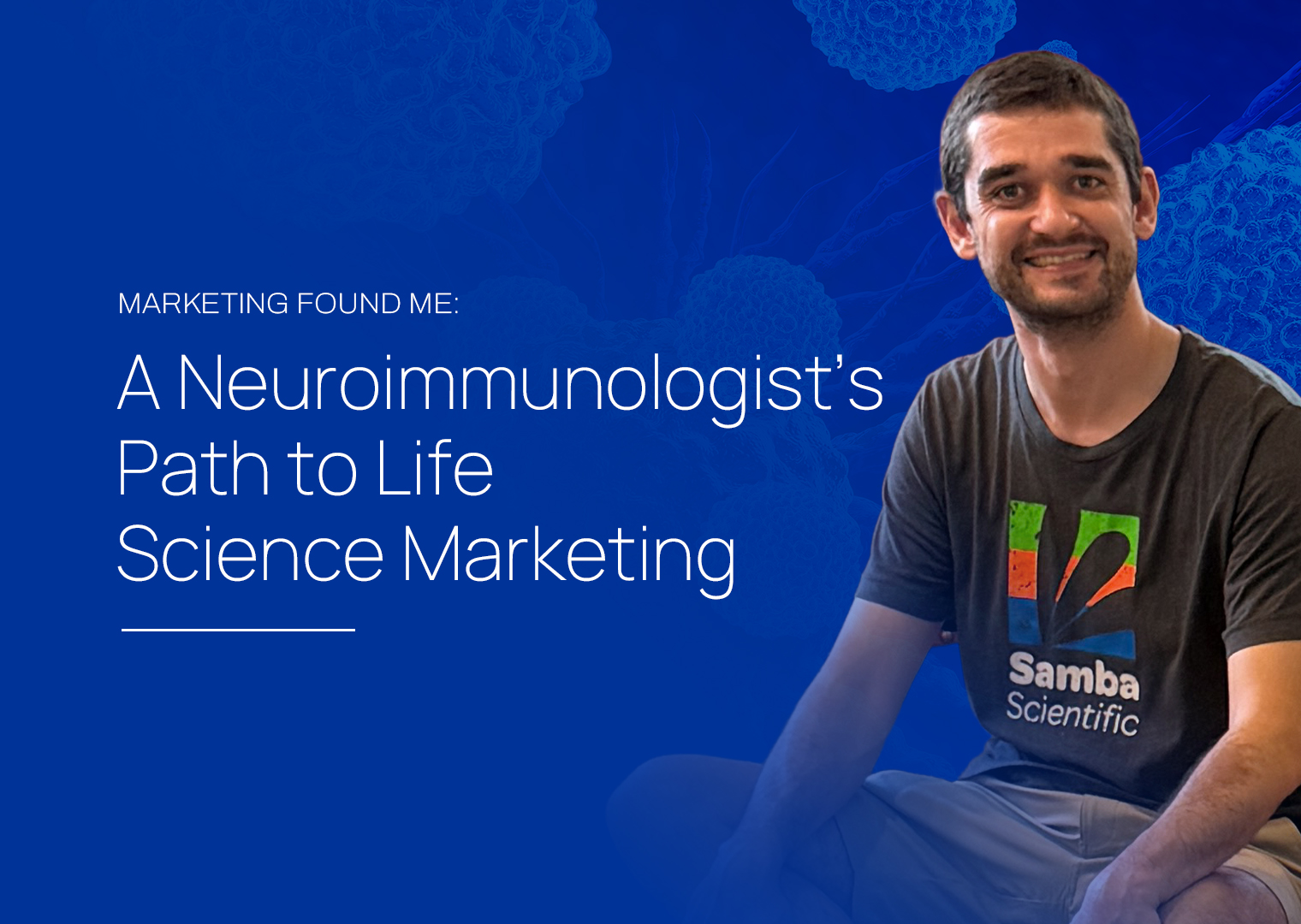
Matías Jaureguiberry, PhD, is a biochemist and neuroimmunologist who spent more than ten years in academia before trading the bench for marketing. We recently sat down with him to pick his brain (metaphorically, of course). He spoke about his path out of the research world, why marketing to scientists works a lot like running an experiment, and why human connection matters more now than ever. Below are a few highlights. Watch the full interview for the whole conversation.
What Does a Senior Account Manager at Samba Scientific Do?
Account managers are the bridge between Samba’s clients and our creative and content teams. All account managers hold PhDs and have strong scientific backgrounds, which allows them to understand our clients’ technology and services, know what will resonate with their target audience, and effectively explain technical concepts to subject matter experts so that they can accurately create marketing assets.
On any given day, Matías might be listening to a client outline their goals, building the strategy to meet them, writing technical content, answering urgent emails, or supporting new business by connecting with prospective clients. He also works closely with project managers to keep every deliverable on schedule across his portfolio of client accounts.
The role, he notes, takes a lot of people skills. Most of the job is communicating clearly with clients and teammates so that everything runs smoothly.
How Does a Neuroimmunologist End Up in Marketing?
In his own words, “Marketing found me.” Matías trained as a biochemist, earned a Master’s in neuroscience and a PhD in biomedicine, and completed a postdoc at Albert Einstein College of Medicine, where he studied the immune system’s role in HIV-mediated cognitive impairments and Alzheimer’s disease. He taught, wrote grants, and even applied for faculty positions. He remains an incredible teacher: at Samba, the team endearingly refers to him as “Dr. Macrophage” whenever he leads internal training sessions.
Midway through his postdoc, a startup that he advised offered him the chance to open a US company from scratch. He said yes—on the condition that it be in Puerto Rico. He moved with two suitcases, five boxes, and his wife, then led the science behind AI models that predict hospital mortality, including securing IRB approval for a clinical trial. Two years later, a Samba job posting caught his eye. Now, four years later, he’s still here (and we’re so glad to have him!).
Why Does Life Science Marketing Need a Scientist's Mindset?
For Matías, marketing is simply another outlet for the skills that he built as a researcher.
“Marketing is no different than being in a laboratory because it means running experiments to see what’s working and what’s not working, analyzing the data, and then making informed decisions from the results that the data give you.”
The teaching side matters just as much. Effective marketing educates, inspires, and reassures rather than interrupting people to push a product.
“What we’re actually trying to do is to invite people to have a conversation with our clients, to learn from them, to see the data for themselves without being sneaky or trying to sell snake oil.”
That approach reflects who Samba’s audiences are: highly trained skeptics who need multiple data points and touchpoints before they trust a solution. Because the team is made up of scientists, Matías says, Samba understands that unique audience from the inside. “We are one of you.”
What Excites Him Most in Biotech Right Now?
An immunologist at heart, Matías points to in vivo CAR T-cell therapies as piquing his interest. He’s fascinated by the progress of CAR T-cells in cancer, including newer approaches for solid tumors, and their expanding use in autoimmune disease. The idea of programming a patient’s own immune system to fight better is, as he puts it, simple in concept but difficult in practice.
He also shared a reminder that he gives to people who are just starting out in science:
“Although from books you will learn dogmas, biology teaches us that nothing is a dogma. Everything changes.”

What Makes Samba Scientific's Culture Different?
Matías says that one of his favorite parts of academia was lunchtime: not just to eat, but sitting down with smart people from all over the world and learning about their science and their lives. At Samba, he gets the same experience with colleagues from across the US.
He credits the culture at Samba to two things. First, the team is professional and good at what it does, but there’s a balance with a laid-back side that particularly comes out at Samba’s annual three-day team retreat (which we call “Samba Jam”). This human element helps to keep team members close, and it also helps with building positive relationships with clients. Second, most team members take part in hiring. The benefit of this is that new colleagues are chosen for their skills and for how well they fit with the people that they’ll work alongside.
Why Does Human Connection Matter More in the Age of AI?
Matías’ biggest insight from his role is that the work is, at its core, about people. He builds real relationships with his clients, which makes honest conversations possible when the data says that a campaign needs to change course.
“At the end of the day, it’s all about humans.”
As AI reshapes marketing, he believes that clients will value that human element even more: someone with real expertise who is invested in their success, and who is willing to think outside of the box to meet their goals.
Watch the Full Interview
These highlights only scratch the surface. In the full conversation, Matías goes deeper into how teaching shapes good marketing, what it took to launch a company in Puerto Rico, and why life science marketing demands so much time and rigor behind the scenes.
Want to work with scientists who speak your audience’s language? Contact the Samba Scientific team to discuss your next launch or campaign.