For the last decade, the marketing playbook was simple: feed the beast. We filled content calendars with holiday graphics, generic product shots, and sanitized press releases to maintain a “consistent cadence.”
In 2026, that strategy is dead.
Biotech audiences, including lab directors, PIs, and clinical execs, have developed an immunity to corporate noise. Concurrently, social platforms have changed how they value content. They no longer reward frequency; they reward retention.
If you are still posting daily “slop” to hit a KPI, you are actively damaging your brand’s reach and signal-to-noise ratio. Here is what the data and experts actually say about social strategy for life sciences this year.
So how do you generate quality leads in the biotech and life sciences space when your buyers are some of the most discerning, scientifically rigorous professionals on the planet? The answer lies in strategies that respect their intelligence, meet them where they are, and leverage the methods that actually work in 2026. Continue reading to explore seven key ideas to integrate into your biotech lead generation strategy.
Key Takeaways:
Stop posting daily. Algorithms now punish “filler” content. One technical post or repost-able pain point is worth ten generic updates.
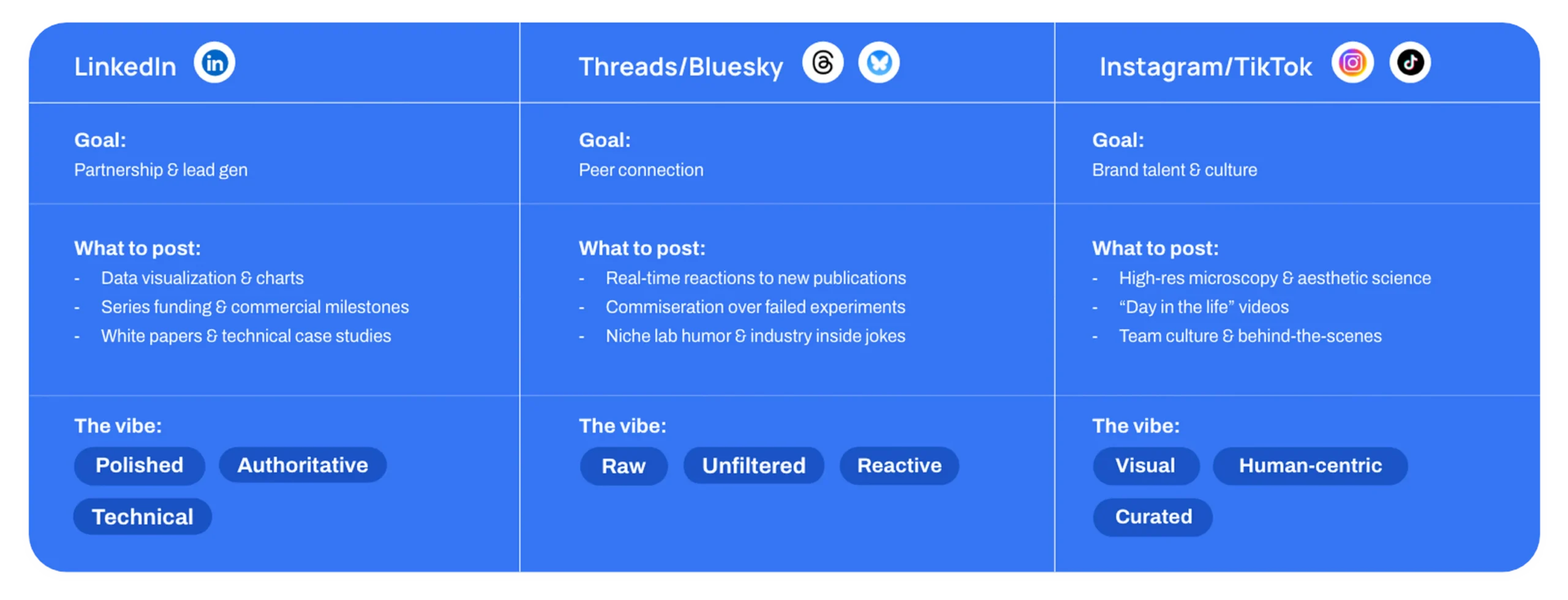
The “Science Twitter” replacement. Discourse has split. LinkedIn is for posters and commercial milestones; Threads and Bluesky are for raw opinion and failed experiments.
Scientists trust scientists. Engagement data shows technical staff outperform brand handles. Let your R&D team post the data (and the jokes).
Social is search. Captions must answer technical questions to be picked up by AI search tools and summaries.
1. Density over Frequency
The era of the daily post is over. Platforms like LinkedIn and Instagram have adjusted their algorithms to penalize accounts that churn out low-engagement filler. If you post a generic “Happy Monday” stock image that gets zero traction, the algorithm assumes your account is low-quality and suppresses your next post, even if that next post is a high-value white paper.
The 2026 strategy is high density. Treat social posts like protocol abstracts. If the content doesn’t teach the viewer something about their field, or it isn’t genuinely relatable and therefore repost-able, save it. One well-researched breakdown of a mechanism of action is worth more than a week of filler. Resonation is key.
2. The "Science Twitter” Platform Split
“Science Twitter” is gone, and nothing has replaced it one-for-one. Instead, the scientific community fragmented into two distinct modes:
- LinkedIn is your presentation hall. This is where the posters go up. It’s the platform for data, commercial milestones, and funding announcements. The tone is professional and polished.
- Threads and Bluesky are the hotel bar. This is where the commiserating conversations happen. It’s where researchers complain about backordered reagents, celebrate grant acceptances, and critique new papers. Success on these platforms relies on that repost-able factor: sharing the specific, painful humor that a bench scientist understands creates a community connection.
Brands usually fail on Threads because they try to paste their LinkedIn strategy there. If you want to exist on the text-forward apps, you have to drop the corporate-heavy PR voice.
3. Employee handles outperform brand logos
Nobody wants to talk to a logo. Trust in corporate handles is dropping, while trust in technical experts remains high.
Hootsuite’s 2026 data confirms that content shared by employees gets significantly higher engagement than the same content shared by the brand. A Senior Scientist explaining why they designed a specific assay is interesting. A marketing account announcing the assay is an ad.
Identify the introverts in your R&D team who are doing cool work. Give them the raw data files and images. Let them write the caption. They can also provide that authentic humor: a scientist making a joke about “Reviewer #2” lands because it is a shared reality, not a marketing tactic.
4. Short-form video as a utility
TikTok and Reels aren’t just for entertainment; they are search engines for product research and methodology.
Brands wasting time on trending audio or “office humor” skits usually miss the mark. The highest ROI comes from utility. A 60-second video showing how to troubleshoot a specific error code on a sequencer or a visual guide to sample prep works because it respects the viewer’s time by providing them with something of value.
A note on generations:
- Gen X (Decision Makers): They respond to problem/solution formats. They remember manual sequencing. Marketing that acknowledges how hard the “old days” were or plays into nostalgia tends to land well.
- Millennials (Lab Managers): They resonate with work-life balance and efficiency. They want to know if your product gets them out of the lab by 5:00 PM.
- Gen Z/Alpha (Bench Scientists): They have the highest radar for “cringe.” Do not try to use their slang. While they appreciate “chaos” edits and memes, stick to authentic lab humor rather than trying to mimic a trend.

5. Social Search and AEO (Answer Engine Optimization)
Social networks are indexing data for AI and have become primary search engines themselves. A researcher is now just as likely to search for “best antibodies for flow cytometry” on Reddit or LinkedIn as they are on Google. Furthermore, tools like ChatGPT and Perplexity scrape these discussions to form their answers.
This evolution requires a tactical shift, especially on platforms like Reddit. Do not masquerade as a neutral party. Getting caught faking grassroots support damages credibility instantly. If you engage, state your affiliation, avoid marketing jargon, and focus entirely on answering technical questions with citations.
Your social captions should be equally technical. Vague, punchy copy fails here. Explicitly state specs, limitations, and data points. If you provide the best technical answer, you win the citation.
6. If it sounds like AI, you lose credibility
These days, AI is everywhere for data analysis and workflows. But using it to write public-facing copy is a liability.
LLMs have a specific “voice.” Words like “delve,” “testament,” “landscape,” and “unwavering commitment”, or overuse of emojis are dead giveaways that content was written by AI. When a scientist reads a post that sounds like it was written by ChatGPT, they assume that you don’t care about accuracy and authenticity. If you cut corners on the copy, they wonder if you cut corners on the validation data.
Write it yourself. It’s better to be slightly imperfect and human than polished and synthetic.
The Bottom Line
Biotech marketing in 2026 isn’t about outsmarting an algorithm. It’s about peer review and understanding that a recent PhD grad on TikTok has different motivations than a VP of Discovery on LinkedIn, even if they are the same person. Your audience is skeptical, tired, and smart. Stop trying to “engage” them with fluff and start giving them the data (or laughs) that they need to do their jobs.
Need help stripping the fluff from your strategy? Samba Scientific specializes in helping biotech companies nail their digital marketing strategies and reach their audiences. Schedule a meeting today.